

Frameless shower glass has become the default specification in upscale Houston bathrooms for reasons that go well beyond aesthetics. The construction eliminates the wear points that destroy framed enclosures, visually opens up small bathrooms, and produces a finished product that reads as architectural rather than catalog-built. This article covers what frameless actually delivers and where the limits are.
Quick Answer
Frameless shower glass uses heavy tempered panels held by clamps and hinges with no perimeter framing. Benefits include longer lifespan, easier cleaning, better light flow, higher resale value, more design flexibility, and elimination of the corroded metal channels that destroy framed enclosures. The tradeoffs are higher upfront cost and a requirement for precise installation.
What Makes Frameless Different from Other Options
Framed shower enclosures surround every glass edge with an aluminum or steel channel. Semi-frameless reduces that framing to the perimeter only, leaving the door itself frame-free. True frameless eliminates framing entirely, using clamps, hinges, and structural silicone to hold heavy-gauge tempered glass in place.
The difference matters because metal framing is exactly where framed showers fail. Water sits in the bottom channel, soap residue builds up in the corners, and the seal between metal and tile breaks down over five to seven years. A framed enclosure that looks fine on day one usually looks tired by year seven and needs replacement by year ten.
Frameless eliminates that failure mode entirely. There is no channel to hold water, no corner for residue to accumulate, and no metal-to-tile transition to fail. The wear points that age-framed showers do not exist in a frameless installation.
Visual and Spatial Benefits
The most immediate frameless benefit is visual. Without metal framing breaking up the panel, the enclosure reads as a single sheet of glass that disappears into the bathroom architecture.
- Light flow. Natural and artificial light pass through unimpeded, making small bathrooms feel measurably larger.
- Tile visibility. Whatever tile, marble, or natural stone is installed inside the shower becomes visible from the main bathroom rather than hidden behind framing.
- Sightlines. Without horizontal or vertical metal divisions, the eye reads the bathroom as one continuous space.
- Hardware as an accent. The hinges and pulls become deliberate design choices rather than necessary infrastructure, which lets homeowners coordinate finishes precisely.
For Houston bathrooms with quality tile work or natural stone, hiding those finishes behind framing is essentially paying twice and showing once. Frameless lets the entire room display what it cost.
Durability and Lifespan Advantages
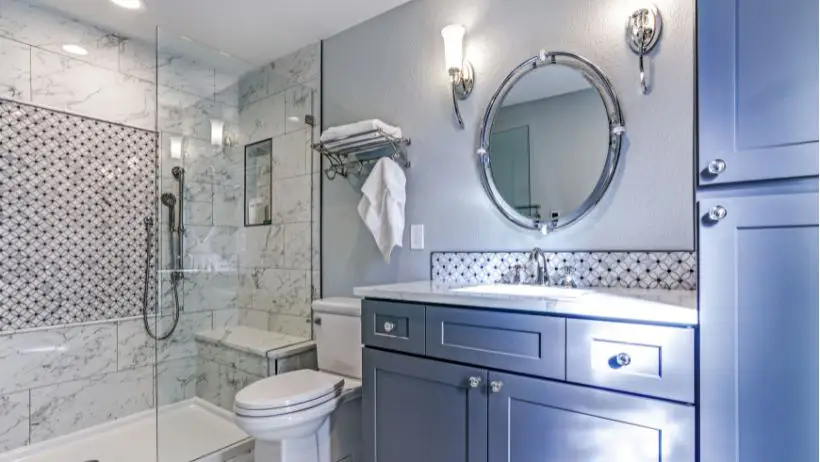 The structural benefit of frameless is rarely discussed but is arguably the most important reason to specify it.
- No metal corrosion. Houston humidity destroys aluminum framing over time. Frameless eliminates the framing entirely.
- No bottom-channel rot. Framed showers trap water in the bottom track, which produces the slow rot that eventually requires full replacement. Frameless drains naturally.
- Heavier glass. Frameless requires three-eighths or half-inch glass, which is structurally more robust than the thinner glass typical in framed enclosures.
- Hardware-only wear points. The only components that wear are the hinges, clamps, and seals, all of which can be serviced or replaced individually without removing the glass.
A properly installed frameless enclosure routinely lasts twenty years or more. Framed equivalents typically need replacement at year ten to fifteen. Over a thirty-year ownership horizon, that is one full additional replacement cycle saved.
Cleaning and Maintenance Benefits
Anyone who has cleaned a framed shower understands the appeal of frameless. The metal channels along the bottom and sides trap soap residue, water, and mildew in ways that no cleaning routine fully addresses.
Frameless cleaning is simpler:
- One continuous glass surface that wipes down in seconds
- No metal corners to scrub
- No bottom channel to harbor water and residue
- No metal screw heads to corrode
- No silicone seam between glass and metal to discolor
Adding a factory-applied protective coating during fabrication reduces maintenance further. With a coating plus a thirty-second daily squeegee, frameless glass stays clear for years without intensive cleaning.
Resale Value and Buyer Perception
Houston real estate listings increasingly call out frameless glass as a feature in primary bathroom descriptions. The reason is buyer behavior. Showings consistently show stronger response to bathrooms with frameless enclosures versus identical layouts with framed or semi-frameless options.
Appraisers do not assign a specific dollar figure to frameless glass alone, but homes with updated frameless bathrooms appraise higher than comparable homes with dated framed enclosures. The category-level resale lift for a primary bathroom upgrade with frameless glass typically recovers sixty to seventy-five percent of installation cost.
For homes in the four hundred thousand and up bracket, where bathroom expectations are higher, the ROI math nearly always favors frameless. For starter homes and rental properties, semi-frameless often makes more economic sense.
Common Mistakes That Undermine Frameless Benefits
Frameless installations fail in specific ways that all trace to skipped corners during specification or installation.
- Wrong glass thickness for door width. A 36-inch wide frameless door in three-eighths glass will sag at the hinges and eventually drag on the threshold. Half-inch glass is the correct specification for wider doors.
- Cheap hinges and clamps. Hardware is doing all the structural work in a frameless installation. Discount hinges fail within a few years of Houston humidity, while premium brass or solid stainless hinges last the life of the enclosure.
- Missing or undersized header. Long fixed panels and wide doors often need an overhead support bar. Skipping this for aesthetics produces flex and eventual hardware failure.
- Inadequate water containment design. The threshold, sweeps, and seals must be designed for the actual water flow expected. Otherwise the bathroom floor takes water every shower.
- Unprepared substrate. Frameless hardware mounts into tile, stone, or framing behind tile. Insufficient blocking behind the wall surface produces hardware that pulls loose under load.
Experienced installers address every one of these during specification. The shower enclosures service walks through configuration and structural considerations before any glass is fabricated.
Frameless Versus Semi-Frameless: Choosing the Right Level
Not every Houston bathroom requires true frameless. Semi-frameless delivers most of the visual benefit at a lower price point and is often the right call for secondary bathrooms.
- True frameless uses heavy glass with no perimeter framing. Highest cost, longest lifespan, cleanest look. Right for primary bathrooms, high-end remodels, and homes where resale matters.
- Semi-frameless uses lighter framing at the perimeter with no framing on the door itself. Mid-range cost, solid lifespan, attractive look. Right for guest baths, secondary bathrooms, and budget-conscious primary remodels.
- Framed uses full framing around every panel. Lowest cost, shorter lifespan, dated appearance. Right for rentals and quick refreshes.
For homeowners weighing frameless against semi-frameless, the deciding factor is usually how long the home will be owned. Owners planning to stay five plus years almost always benefit from frameless. Owners planning shorter ownership often find semi-frameless delivers better return on investment.
DIY Versus Professional Installation for Frameless
Frameless is the worst possible DIY category. The panels are heavy, often weighing eighty to one hundred and fifty pounds. The tolerances are extremely tight. Hardware mounting requires precise drilling into tile and substrate. A measurement error or installation mistake produces a destroyed custom panel and a multi-week reorder.
There is essentially no scenario where DIY frameless installation makes sense for a Houston homeowner. The cost savings against a professional install are minimal, the risk of damage is high, and the warranty coverage of professional installation has real value.
Professional installation includes structural review, custom fabrication coordination, on-site measurement, substrate verification, and warrantied workmanship. That is the right approach for a five thousand dollar bathroom feature that needs to last two decades.
Why Choose Northwest Glass & Mirror
Experience. Since 1978, Northwest Glass & Mirror has installed frameless shower glass across every type of Houston home, from historic bungalows in The Heights to new construction in Cinco Ranch and Bridgeland. Four decades of frameless installations have produced a team that understands every configuration challenge.
Reliability. The same crew handles design consultation, measurement, fabrication, and installation. There is no subcontracted handoff and no national-chain pricing matrix that ignores the specifics of the project.
Quality and technology. Standard offerings include heat-soaked tempered glass, low-iron upgrades, factory-applied protective coatings, premium pivot and wall-mount hinges, and custom hardware finishes. Every enclosure meets ANSI Z97.1 and CPSC 16 CFR 1201 safety standards.
Service area and coverage. From the Inner Loop through Memorial, Katy, Cypress, Spring, The Woodlands, Sugar Land, and Pearland, Northwest Glass covers the full Houston metropolitan area. To see completed frameless projects, browse the project gallery or learn about the company on the about page.
Frequently Asked Questions
How much more does frameless cost than framed shower glass?
Frameless typically runs forty to seventy percent more than a comparable framed enclosure. A framed unit might install for fifteen hundred dollars while an equivalent frameless project runs three thousand to four thousand. The price difference reflects heavier glass, premium hardware, and more precise installation. The quote request form returns project-specific numbers within two business days.
How long does frameless shower glass last?
A properly installed frameless enclosure routinely lasts twenty years or more. Hardware components such as hinges and seals may need refresh every ten to fifteen years, but the glass itself, when correctly specified and installed, often outlasts the bathroom surrounding it.
Is frameless harder to keep clean than framed?
The opposite. Frameless is significantly easier to clean because there are no metal channels, corners, or seams to trap water and residue. A daily squeegee plus weekly glass cleaner wipe-down handles ninety percent of maintenance. Factory-applied protective coatings further reduce mineral buildup in Houston water.
Can frameless work in small bathrooms?
Yes, often better than alternatives. Without framing breaking up the space, small bathrooms read as visually larger with frameless installations. Neo-angle and corner configurations work well in tight footprints, though precise measurement and design review are essential to ensure the door swing and clearance function in the available space.
Will I need to reinforce my walls for a frameless installation?
Sometimes. Frameless hardware mounts into the wall behind the tile, and adequate blocking is required to support the load. New construction can include this from the start. Retrofit projects sometimes need wall opening to add blocking, which a professional installer identifies during the initial measurement.
Ready to see what frameless looks like in your bathroom? Contact Northwest Glass & Mirror for a design consultation, or explore available glass types to start narrowing options.